
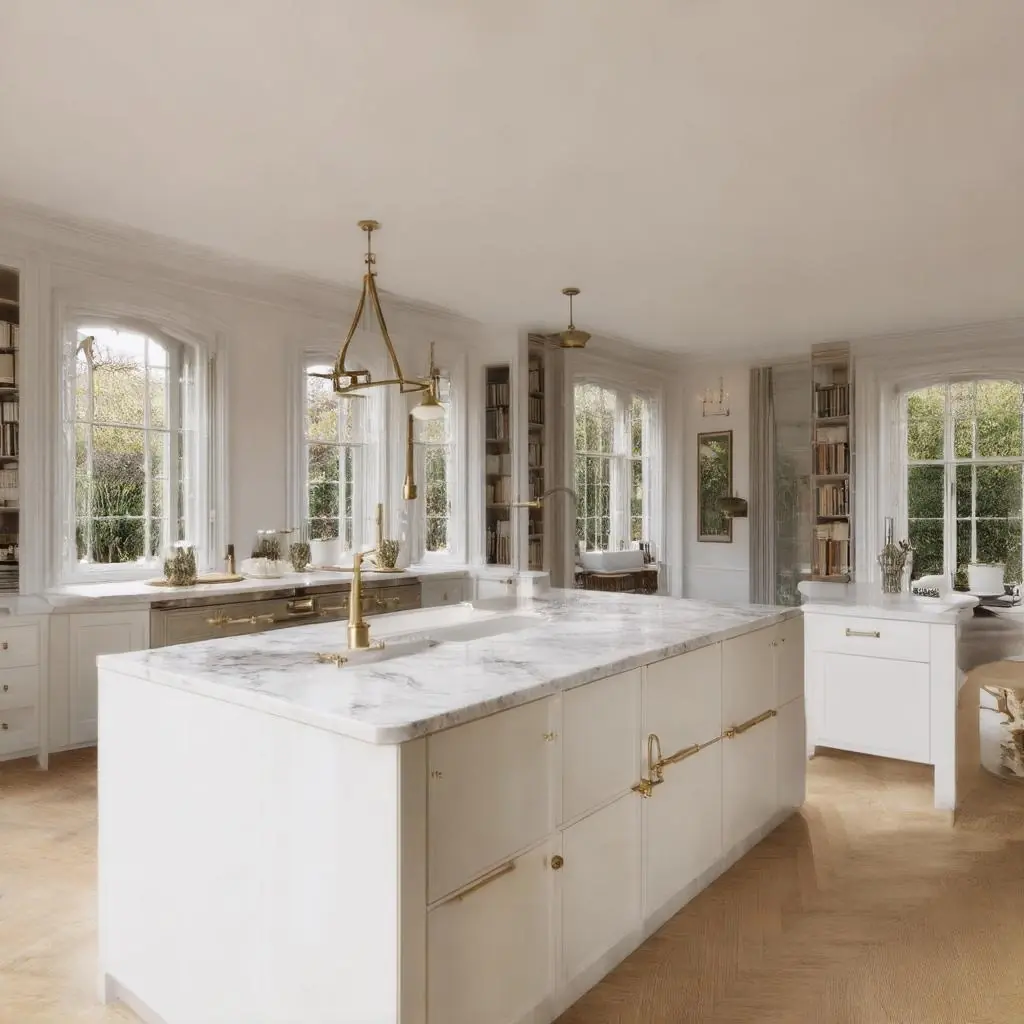
A newly listed high-end apartment in a historic West London redevelopment offers a snapshot of London’s current design language: original proportions and classical detailing preserved, with crisp, contemporary interventions layered in for comfort and performance. Kitchens in these spaces feel refined yet effortless—quietly opulent, highly functional, and visually coherent with adjacent living areas. Achieving that same balance in your own home starts with the worktop, the largest single surface that unifies a kitchen.
Material choices set the tone. Classic, veined marble-inspired surfaces channel heritage architecture, while engineered quartz delivers day-to-day practicality for busy urban living.
-
Marble-inspired surfaces vs engineered quartz: Veined marble (or marble-look quartz) evokes the romance of period mouldings and stone stairwells found across West London mansion blocks. Real marble offers unmatched natural movement and depth; in calmer palettes—soft whites, dove greys, and subtle taupes—it reads timeless and quietly grand. However, marble is porous and can etch with acids and stain without careful sealing and maintenance. If you love the look but require resilience, consider engineered quartz. High-quality quartz offers excellent stain resistance, low porosity, and minimal upkeep—ideal for families, rental portfolios, and open-plan spaces where kitchen and living blur. Many quartz designs now capture the nuanced veining and feathered clouds of natural stone with impressive fidelity.
-
Where real stone shines—and when to choose a low-upkeep alternative: For feature islands that will be carefully used and enjoyed, real marble or a richly grained granite can become the room’s sculptural centrepiece, especially when paired with sympathetic lighting and hardware. For heavy-use perimeters, homes with frequent entertaining, or projects with maintenance-light briefs, quartz is typically the better investment. Toucanstone’s quartz collections—such as Arctic Starlight, Marbella, Highlands, and Florence—deliver the elegance of pale, refined stone with excellent performance and competitive pricing from approximately £152 to £181 per square metre.
Finishes are equally influential. In London’s light-filled, high-ceilinged rooms, you will often see a deliberate interplay between sheen and texture.
-
Polished: Maximises light bounce and gives a crisp, gallery-like quality—ideal for darker rooms or compact flats that benefit from brightness. Polished surfaces are easy to wipe clean, though they show fingerprints more readily on darker colours.
-
Honed: Matte to satin sheen that feels refined and contemporary. Honed finishes soften reflections for a calmer, stone-forward look, and they disguise micro-scratches well. On very pale colours, honed can be marginally more receptive to staining, making quartz a smart choice if you prefer this touchable finish with less upkeep.
-
Leathered: A softly textured surface that brings tactile luxury and depth, especially effective on stones with pronounced movement. Leathered finishes excel at masking fingerprints and day-to-day wear, and they read beautifully in heritage settings where subtle texture harmonises with original features.
Edges, Form, and Metal Accents: Sculptural Details for Open-Plan Living
In the best West London redevelopments, kitchen islands behave like fine furniture—monolithic yet refined, sculptural yet practical.
-
Waterfall ends: Continuing the worktop down the sides of an island creates a seamless “stone block” effect. When working with veined materials, careful vein-matching at the mitred corners ensures the pattern flows naturally, enhancing the impression of a single slab.
-
Mitred profiles and thicker builds: A 20 mm or 30 mm slab can be mitred at the edge to create the visual weight of a 50–60 mm build without excessive material consumption. This technique delivers a luxurious presence that suits generous proportions and helps the island read as a contemporary statement piece.
-
Edge profiles: For modern-classic kitchens, an eased square or pencil round keeps lines crisp while easing sharpness. If you wish to nod to period detail, a delicate ogee can be used on a dresser or servery while retaining modern edges on the island for contrast.
Metalwork is the quiet hero that completes the palette. Warm metals—brass and bronze in particular—bring depth to pale stones without overwhelming them.
- Pairing with metals: Satin or brushed brass handles, trims, and taps add warmth that flatters soft whites and gentle greys. PVD-style finishes offer the appearance of solid brass with enhanced durability and colour consistency—useful in high-traffic kitchens. Antique brass pairs beautifully with veined marble tones; brushed bronze tempers the sparkle of Arctic or starlit quartz with a more grounded, architectural character. Keep the metal language consistent across taps, sockets, lighting, and even plinth details to maintain a calm, coherent scheme.
Indoor–Outdoor Continuity, Colour Palettes, and the London Light
Many London homes open onto terraces and balconies. Extending your worktop language outdoors reinforces visual continuity and makes entertaining feel effortless.
-
UV and weather resilience: Not all engineered quartz is rated for prolonged UV exposure; discuss outdoor suitability at the specification stage. For exterior counters, granites typically offer excellent UV stability and weathering performance when professionally sealed; select finishes that provide grip in damp conditions. If you choose quartz outdoors, ensure it is explicitly rated for exterior use.
-
Slip and stain considerations: On terraces, favour honed or leathered finishes for better traction. Choose mid-tone or gently variegated patterns to disguise urban dust and rainfall marks. Specify robust edge details and adequate overhangs to shed water away from cabinetry.
-
Colour palettes for London’s architecture: Soft whites, warm greys, and stones with subtle movement sit comfortably alongside stuccoed façades, sash windows, and cast-iron balconies. In compact kitchens, pale quartz with fine, light veining amplifies daylight. In larger rooms, a slightly deeper grey with feathered veining adds gravitas without feeling heavy. Aim for tonal layering—pale worktops, a whisper-grey cabinet, and warm metal accents—so the space feels coordinated but not flat. Where a bolder statement is desired, choose one dramatic feature slab on the island and keep perimeters quieter for balance.
Planning for Precision: Templates, Cut-Outs, Splashbacks, and Timelines
Delivering a luxury result is as much about planning as it is about product. Toucanstone supports homeowners and interior designers with sample-led decision making, accurate templating, and meticulous installation across London and the South.
-
Measuring tips before survey:
- Sketch your layout with overall lengths and depths; note appliance positions, window reveals, and door swings.
- Allow typical worktop depths (600–650 mm), accounting for cabinet handles and wall irregularities.
- Flag overhangs for breakfast bars and seating; structural supports may be required for cantilevers over 300 mm.
- Check levels across cabinetry; stone performs best on a flat, well-braced substrate.
-
Appliance and sink cut-outs:
- Specify undermount sinks with drainer grooves for a refined, hotel-grade look; choose polished, honed, or leathered grooves to match the surface.
- For hobs, allow adequate expansion gaps per the manufacturer and request reinforcement as needed around wide cut-outs.
- Position tap holes and accessory wells (filtered water, instant hot) early to ensure clearances to drawers and waste kits.
- For veined stones, discuss vein direction and bookmatching so cut-outs land sympathetically within the pattern.
-
Splashback coordination:
- A 100 mm upstand in the same stone offers a clean datum; pair with painted or microcement walls for a gallery feel.
- For full-height splashbacks, consider the same slab for a seamless, monolithic look—particularly effective behind a range cooker or on a single feature wall.
- Alternatively, combine stone worktops with fluted tiles or antique mirror for a heritage nod; keep grout lines fine and aligned to cabinetry.
-
Templates to installation:
- Toucanstone provides free, no-obligation quotes within two days based on your plans or a site visit.
- A dedicated templater captures exact site conditions, junctions, and cut-outs, and discusses edge profiles, seams, and vein direction with you on the day.
- Typical fabrication and installation timelines are confirmed at survey; your project manager will coordinate access, appliances on site, and final checks so installation proceeds smoothly.
- Post-installation, Toucanstone offers guidance on care and maintenance, and quartz worktops carry a 10-year warranty for peace of mind.
Interior designers benefit from trade-friendly coordination—sample sets for client presentations, consistent batch control for colour matching, and detailed CAD from template data to sign off with your wider project team.
Budgeting for a Luxury Finish: Where to Invest, Where to Save
London luxury does not require an unlimited budget; it demands smart allocation.
-
Invest here:
- The island: A feature slab with mitred waterfall ends delivers maximum visual impact and becomes the anchor for open-plan living.
- Vein-matched details: Bookmatched corners and aligned seams elevate the craftsmanship and read as truly bespoke.
- Tactile finishes: A leathered or honed surface on the island adds sensory richness that guests notice immediately.
-
Save smartly:
- Perimeter runs: Choose a complementary but simpler quartz to support a statement island; keep edges to an eased square to reduce fabrication cost.
- Thickness strategy: Use standard 20 mm or 30 mm slabs with mitred build-ups only where the thicker look is required.
- Rationalise cut-outs: Consolidate small accessories and choose integrated drainer grooves rather than separate drainers to control costs.
- Consider Toucanstone’s value-led quartz ranges: Arctic Starlight, Marbella, Highlands, and Florence deliver a sophisticated palette from approximately £152 to £181 per square metre, thanks to Toucanstone’s direct-to-consumer model that removes middlemen.
-
Make decisions with confidence:
- Request free samples to assess colour, veining, and finish in your own light conditions; compare against cabinetry, flooring, and metalwork.
- Book a home consultation to review options in situ and confirm practical details like seating overhangs and power point positions.
- Use Toucanstone’s templating expertise to finalise edge profiles, seam positions, and vein direction before fabrication, avoiding costly changes later.
Whether you are renovating a townhouse in Kensington, opening up a terrace flat in Hammersmith, or fitting out a new-build in Battersea, the combination of considered material selection, sculptural detailing, and precise execution will deliver the modern-classic London look. Toucanstone’s family-owned team in Dunmow, Essex—serving London and the South—partners with you from first sample to final polish, ensuring your worktops capture the capital’s blend of heritage character and contemporary luxury, and perform beautifully for years to come.